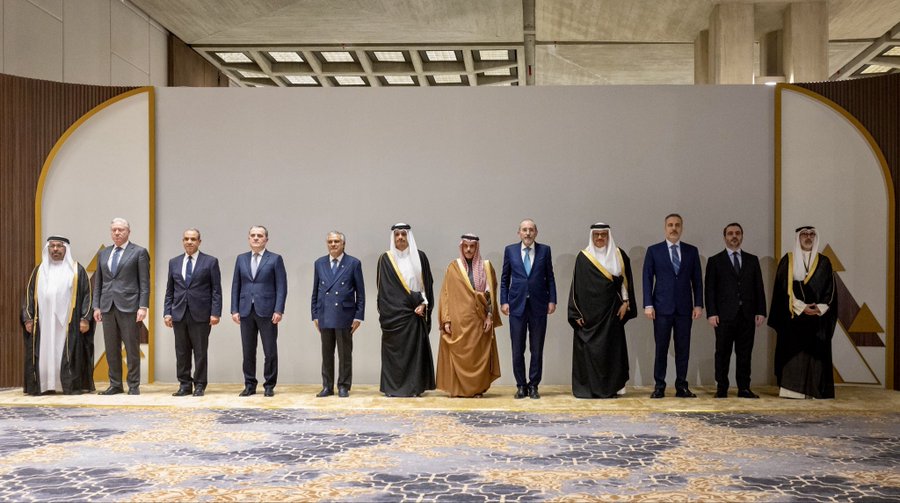
Foreign ministers from Arab and Islamic countries have issued a strong joint condemnation of Iran over a wave of missile and drone attacks targeting several nations across the region, warning that the strikes threaten sovereignty, civilian safety, and regional stability.
Meeting in Riyadh on Thursday, the ministers described the attacks on Gulf states, Jordan, Azerbaijan, and Türkiye as unjustifiable under any circumstances, stressing that such actions violate international law and undermine efforts to ease tensions. They affirmed that countries affected by the strikes have the right to defend themselves under Article 51 of the United Nations Charter.
The consultative ministerial meeting brought together representatives from Azerbaijan, Bahrain, Egypt, Jordan, Kuwait, Lebanon, Pakistan, Qatar, Saudi Arabia, Syria, Türkiye, and the United Arab Emirates, as concern grows over escalating hostilities linked to Iran’s military actions.
In their joint statement, the ministers said Iranian strikes had hit residential areas and key civilian infrastructure, including oil facilities, desalination plants, airports, residential buildings, and diplomatic premises. They said these targets point to deliberate actions that put civilian lives and essential services at risk.
They emphasised that “such attacks could not be justified under any pretext or in any manner whatsoever.”
The ministers called on Iran to immediately stop the attacks and respect international law, humanitarian rules, and the sovereignty of neighbouring states, describing this as a necessary step toward calming tensions and opening the door for dialogue.
They also underlined that the future of relations with Iran will depend on its willingness to respect borders, avoid interference in the affairs of other countries, and stop using military means that threaten regional security.
Part of their concern focused on Iran’s links with armed groups in several Arab countries. The ministers urged Tehran to halt support, funding, and arming of such groups, saying these actions serve Iran’s interests while harming regional stability.
The statement also raised alarm over threats to global shipping routes, warning against any attempts to block or disrupt movement through key waterways such as the Strait of Hormuz and Bab al-Mandab. The ministers said protecting maritime security remains critical for the region and the wider world.
Lebanon received special mention in the discussions, with the ministers expressing support for its sovereignty and backing the government’s decision to restrict weapons to state control. At the same time, they condemned Israel’s actions in Lebanon, saying its expansionist policies add to instability.
The meeting comes against the backdrop of a wider conflict involving Iran, the United States and Israel, which intensified in late February 2026 following coordinated strikes on Iranian military and energy sites, including Kharg Island and South Pars.
Those attacks were aimed at weakening Iran’s military reach and limiting its nuclear and missile capabilities. In response, Iran launched retaliatory strikes not only against Israeli and US targets but also against Gulf countries it views as aligned with Washington and Tel Aviv.
While Tehran has framed its actions as retaliation, countries in the region see them as direct violations of their sovereignty, prompting a unified response from Arab and Islamic nations.
The ministers said the latest escalation, marked by ballistic missile and drone attacks, poses a serious challenge to regional security and global norms. They pointed to United Nations Security Council Resolution 2817 (2026), which calls on Iran to stop all attacks and avoid actions that could further inflame tensions, including threats to close key maritime routes.
They pledged to continue close consultation and coordination to track developments, assess risks, and agree on joint responses, including taking “necessary legitimate measures and procedures” to protect their security and stability.
In closing, the ministers stressed that cooperation and sustained dialogue will be key to addressing the crisis, maintaining stability, and ensuring that attacks affecting the region do not continue unchecked.